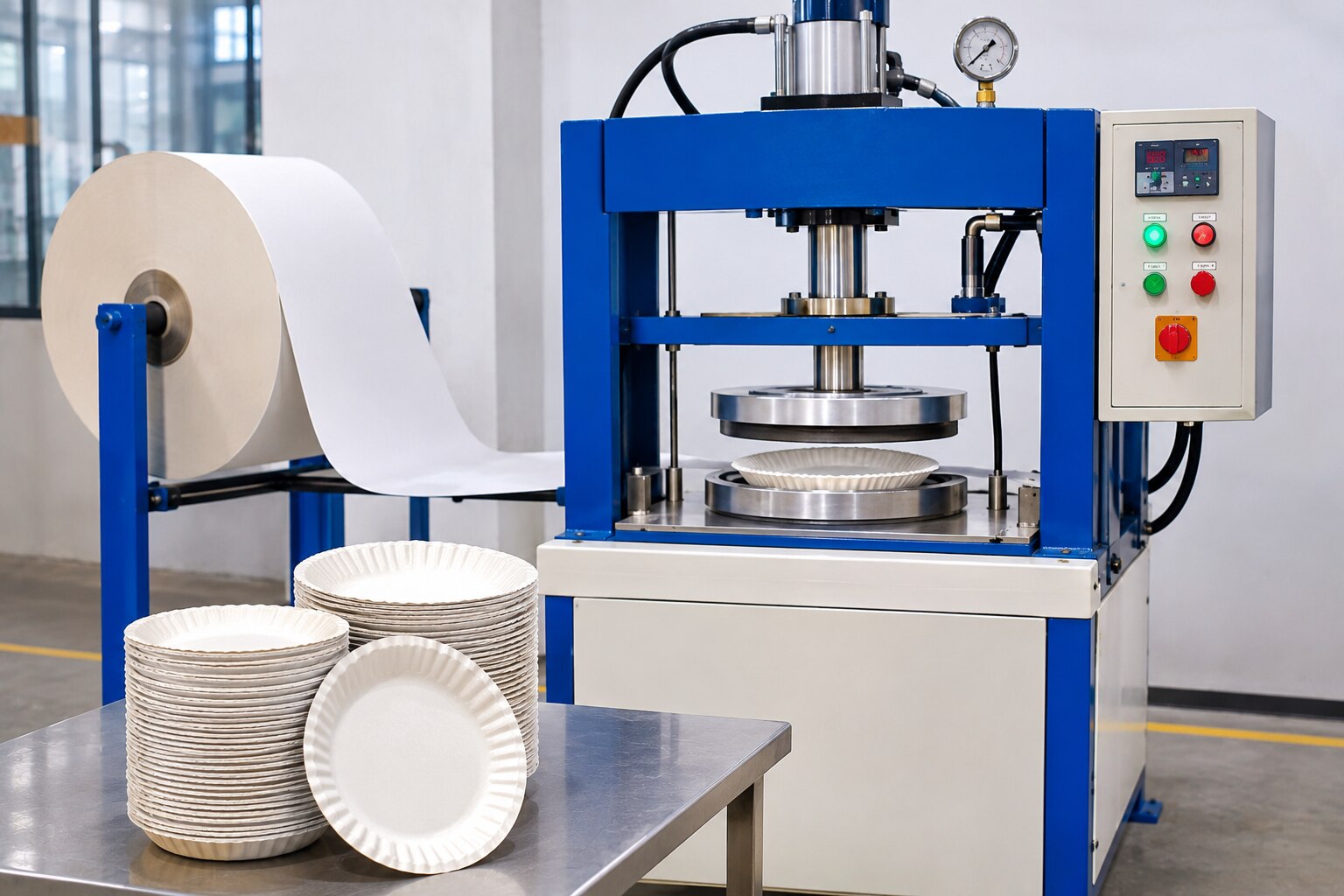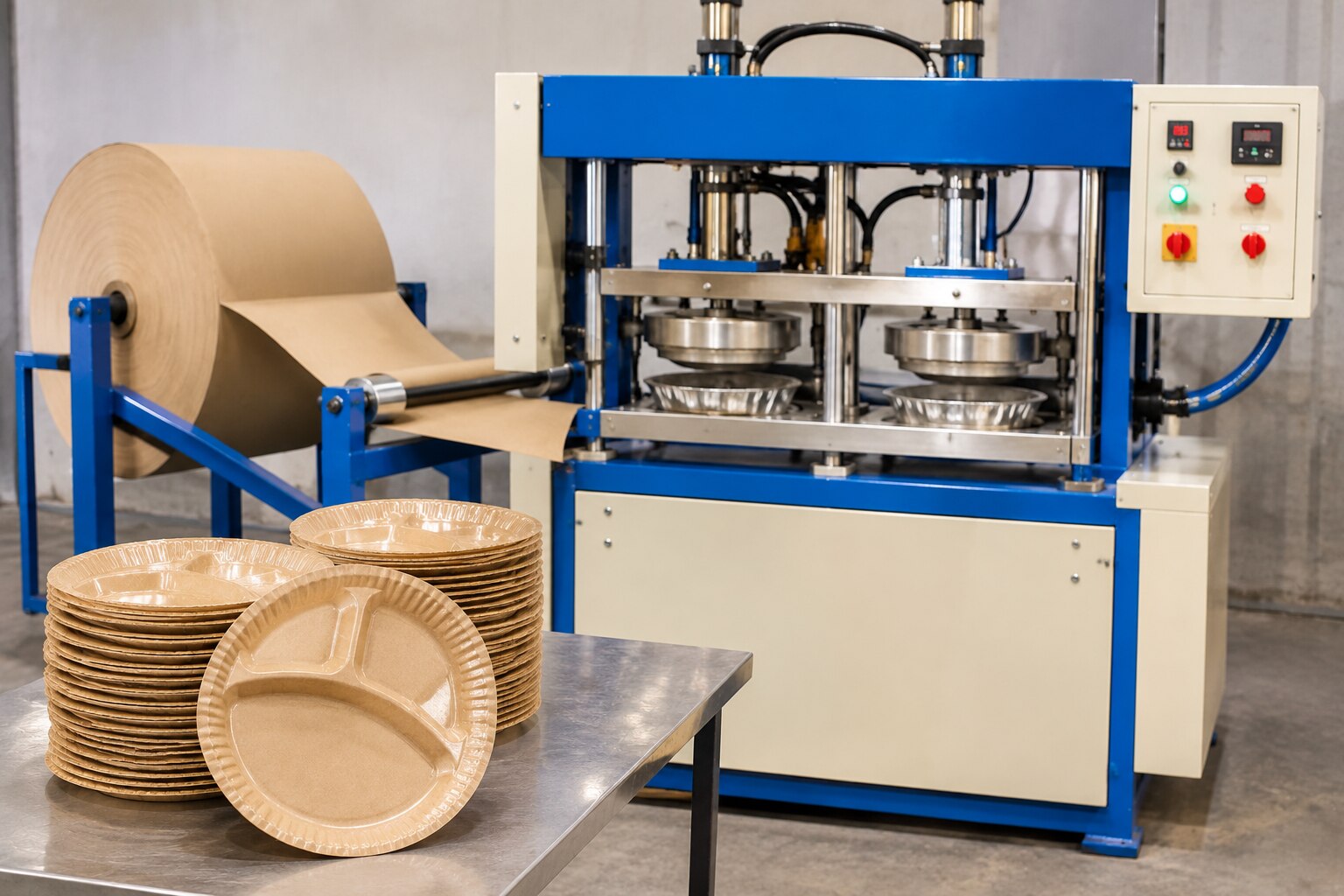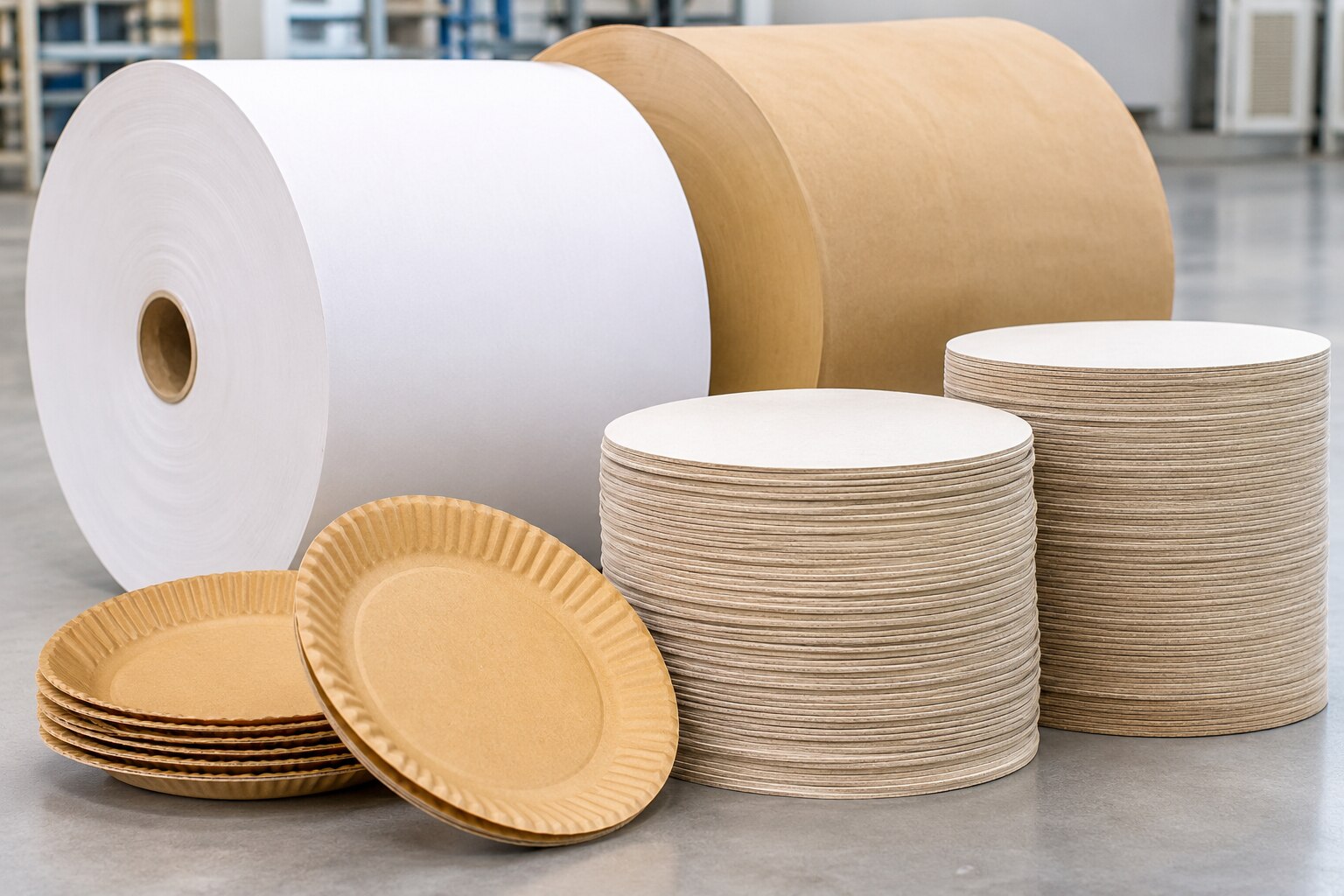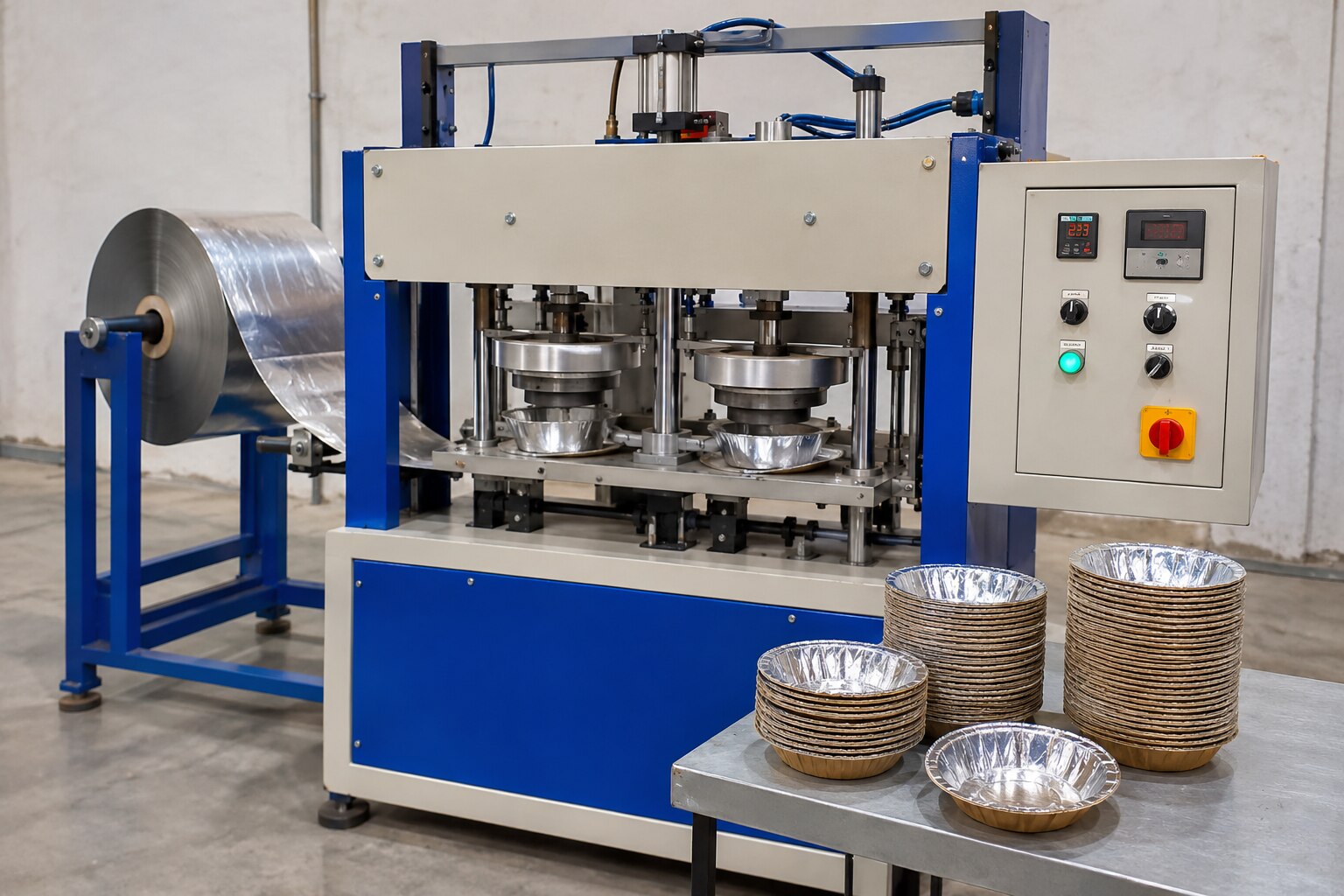
A machine’s advertised cycle speed tells you little if you do not know its accepted output, paper limits, tooling, utilities, labour needs and reject rate. By the end, you will have a question-by-question checklist for testing the quotation, witnessing a production trial and comparing the machine’s real operating cost.
Key takeaways
- Request accepted plates per hour for every diameter, depth and paper specification.
- Ask whether one machine supports your required plate sizes, depths and die changes.
- Obtain electrical, drive, control, safety and maintenance specifications before ordering.
- Calculate costs for operation, changeovers, rejected plates, servicing and replacement parts.
What output will the machine deliver with my paper, sizes and operators?
The figure you need is accepted plates per hour for every target plate diameter, depth and paper specification—not merely cycles per minute or strokes per minute. Request separate figures with one die installed and with all installed dies, then ask whether each figure includes loading, unloading, stacking, counting, trimming, die changes and rejected plates.
That distinction separates press capacity from sellable output.
| Option | What to confirm | Output risk |
|---|---|---|
| Blank-fed machine | Separate circle-cutting, manual blank loading and transfer | Cutting and feeding labour may be excluded |
| Roll-fed machine | Unwinder, web alignment, cutting and waste-removal equipment | Upstream equipment may be excluded |
| Blank-fed machine versus roll-fed machine | Complete line layout and included operations | The quoted production capacity may cover only forming |
Ask how many operators the machine requires and assign every task in writing: paper feeding, die loading, stacking, counting, packing and quality inspection. A fast press does not deliver its quoted output if one worker must feed blanks and stack plates simultaneously.
Request a production log from a continuous trial using your paper and each target format, not a short demonstration. The log must show input quantity, accepted plates, rejects, downtime, changeovers and actual running hours.
Ask for the input-to-product yield as well: record trim and unusable waste separately, because material loss can cost more than a small difference in press speed.
Will the machine form the paper stock and product formats I actually need?
A machine that accepts one paper grade may fail on another, so match the forming range to your purchase plan before comparing cycle rates.
1. Request a written usable-material range covering GSM, paper thickness, grammage tolerance, moisture condition, blank diameter range, and roll or sheet dimensions. Name the coating in the quotation: single-side PE, double-side PE, PLA, water-based coating, or uncoated paper. Require a trial using the exact stock you will buy, including its blank size and moisture condition.
PE-coated paper or PLA-coated paper can crack, delaminate, or spring back even when uncoated paper forms correctly.
2. Ask for supported finished plate diameter, rim height, plate depth, rim profile, wrinkle pattern, thali shape, and dona diameter. The maximum advertised diameter proves little if the machine cannot form a deep rim or sharp embossing at that size.
Ask how pressure or position feedback, dwell time, mould temperature, overload protection, and paper-thickness compensation maintain shape during continuous production.
3. Obtain a drawing for every included mould and a list of optional dies showing price, lead time, storage requirements, and interchange procedure. Ask how long a real format change takes, whether it needs hydraulic-pressure, servo-position, dwell-time, or PLC adjustments, and how many operators are involved.
Confirm whether each blank size is cut by the forming machine or supplied by separate cutting equipment.
Which drive, electrical and control specifications will the machine require?
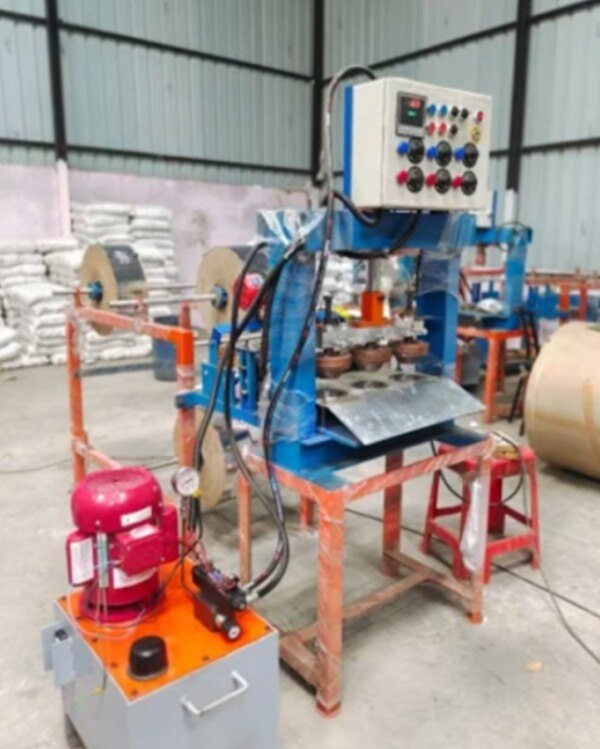
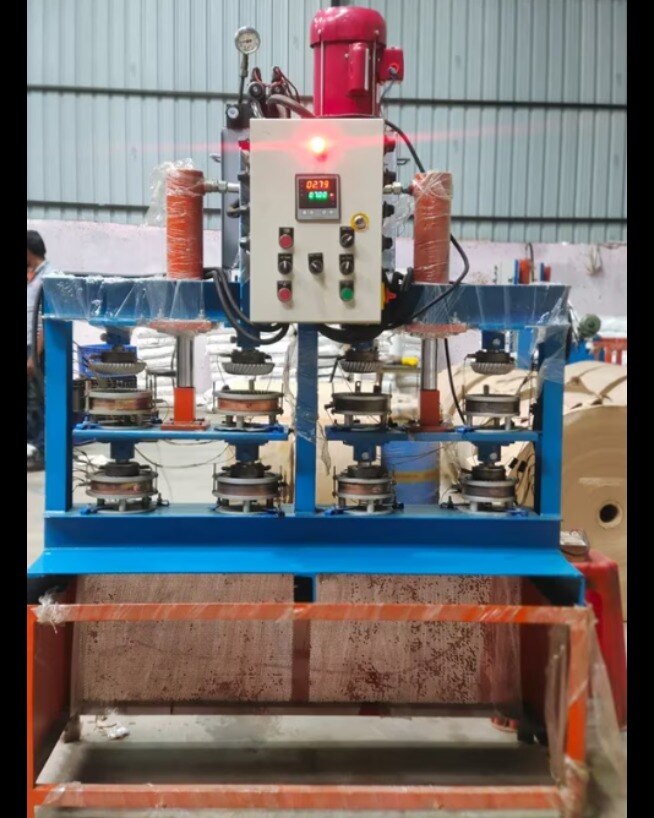
Ask the manufacturer to identify the drive system in plain terms: hydraulic, pneumatic, mechanical, servo-driven or a combination. Match it to your production pattern, not to a sales label.
| Drive type | Main advantage | Questions to ask |
|---|---|---|
| Hydraulic | High forming force and adjustable pressure | How will oil temperature, leaks and filters be managed? |
| Servo-driven press | Precise position and speed for repeatable motion | What position feedback, dwell control and overload protection are included? |
| Pneumatic | Suitable for light clamping and auxiliary actions | Is compressed air being used for forming beyond its practical force? |
| Mechanical | Simple, fast, fixed motion | How are force, stroke and format changes controlled? |
For a hydraulic paper plate machine, request the nameplate photograph or datasheet. It must show:
- Connected load in kW and normal running load
- Voltage, phase, frequency, motor rating and hydraulic-pump rating
- Control-panel specification and PLC and HMI specification
- Compressed-air pressure in bar and consumption in litres per minute, if applicable
- Ventilation requirements and recommended foundation or floor loading
Ask for the difference between rated forming force and force available at the actual speed and stroke. Insufficient force or uncontrolled dwell can produce incomplete rims, uneven embossing, cracking and inconsistent depth.
Finally, confirm how pressure or position feedback, dwell time, mould temperature and paper-thickness variation are controlled during continuous production. A supplier that cannot quantify these controls cannot prove that nominal cycle speed will produce consistent plates.
What acceptance test, safety documentation and maintenance support will I receive?
Put the production acceptance test and its pass/fail criteria into the purchase contract before paying. Run the machine long enough to expose hydraulic-oil heating, paper buildup, sensor faults and die wear; a short sample proves little. Measure:
- Finished-plate diameter, rim height, plate depth and flatness
- Stacking quality, visual defects and reject percentage
Define the numerical tolerance for each result, the paper specification, die used, test duration and who pays for correction or repeat testing.
Safety evidence must cover the installed machine, not just display a CE mark.
| Check | Evidence to request |
|---|---|
| Fixed and interlocked guards | Inspection around the forming area |
| Emergency stops and restart prevention | Functional test after power loss |
| Die-change mode and overload protection | Demonstration with controls identified |
| Maintenance lockout points | Marked isolation points and lockout instructions |
| Control-system safety | Risk assessment citing ISO 12100 and ISO 13849-1 |
For food-contact production, obtain food-contact documentation and test reports for paper, coatings, inks, adhesives, lubricants and product-contact machine surfaces. EU buyers should request evidence against Regulation (EC) No. 1935/2004 and GMP Regulation (EC) No. 2023/2006, plus the machinery rules applying on the installation date, including Regulation (EU) 2023/1230 from 20 January 2027.
Request the risk assessment, instructions, guarding details and declaration of conformity.
Get maintenance intervals and wear limits for dies, bearings, seals, heaters, sensors, stacking parts and cutting tools. Require hydraulic-service instructions and PLC, software and HMI backups before commissioning.
What will the complete machine cost to operate, change over and keep running?
Demand one line-item quotation before comparing machines: machine, included moulds, optional moulds, blank-cutting equipment, installation, commissioning, freight, taxes, training and spare parts. Ask whether the machine is blank-fed or roll-fed, and price excluded cutting, unwinding, alignment or waste-removal equipment.
Require the percentage of each blank that becomes an accepted product, trim or unusable waste for every plate format. Ask whether the blank layout is fixed or optimised for each format; paper yield can outweigh a small press-speed advantage when paper is your main operating cost.
| Setup | Costs to calculate | Evidence to request |
|---|---|---|
| Single-size | One mould, storage, alignment and maintenance | Die price, life and replacement lead time |
| Multi-size | Additional dies, die changeover time and labour | Change procedure, parameter changes and storage method |
| Blank-fed | Cutting, handling and blank waste | Upstream equipment scope and yield by format |
| Roll-fed | Unwinding, web alignment, cutting and waste removal | Included components and continuous-trial output |
Calculate total cost of ownership using accepted plates per hour, stated reject rate and material yield—not cycles per minute. Include die storage, alignment time, replacement-tool lead time and preventive-maintenance parts.
Define after-sales service in writing: warranty duration and exclusions, commissioning scope, operator training, remote diagnostics, technician response time and spare-parts availability. Ask whether seals, sensors, heaters and bearings are locally available, whether imported parts have stated lead times, and whether PLC and HMI backups are supplied.
Shivansh Engineering should receive the same paper samples, drawings, output targets and acceptance limits as every competing supplier.
Related products
 | Paper Plate Circle Cutting Machine Paper Plate Circle Cutting Machine ₹160000 A Paper Plate Circle Cutting Machine is an essential tool for manufacturers producing paper plates, donas, and disposable tableware. View product → |
 | Paper Plate Making Machine Automatic Hydraulic Double Die Paper Plate Making Machine ₹120000 The Automatic Hydraulic Double Die Paper Plate Making Machine is one of the most reliable and efficient solutions for manufacturers seeking faster... View product → |
Frequently asked questions
What output figure should you request from a paper plate machine manufacturer?
Request accepted plates per hour for each target diameter, depth and paper specification. Ask for separate figures with one die installed and with all installed dies, including loading, unloading, stacking, counting, trimming, die changes and rejected plates.
How can you confirm that the machine will make your required paper plate formats?
Give the manufacturer your paper specifications, target plate diameters, depths and product formats. Confirm which dies and forming arrangements support each product and how changing between formats affects production.
Which machine specifications should you confirm before purchase?
Ask for the drive arrangement, electrical supply requirements, control system specifications and any installation requirements. Match these details with your available power supply, operators and production site.
What documents and support should you require with the machine?
Request the acceptance-test procedure, safety documentation, operating instructions, maintenance schedule, spare-parts information and details of after-sales technical support.
Which costs belong in the total cost of operating a paper plate machine?
Include power, operators, paper waste, rejected plates, tooling and die changes, cleaning, routine maintenance, replacement parts and downtime during format changes or servicing.
Related products
 | Automatic Paper Plate Making Machine Fully Automatic All-in-One Paper Plate Machine ₹340000 The Fully Automatic All-in-One Paper Plate Machine is the ultimate choice for entrepreneurs and manufacturers who want a high-performance,... View product → |
 | Automatic Paper Plate Making Machine Semi Automatic Hydraulic 4 Die Wrinkle Paper Plate Machine ₹180000 The Semi Automatic Hydraulic 4 Die Wrinkle Paper Plate Machine is a powerful and efficient production solution designed for manufacturers who want to... View product → |
 | Automatic Thali Making Machine Semi Automatic Hydraulic 8 Die Wrinkle Paper Plate Machine ₹290000 A Semi Automatic Hydraulic 8 Die Wrinkle Paper Plate Machine is a powerful and efficient manufacturing unit designed for high-volume production of... View product → |
 | Paper Dona Making Machine Paper Triple Die Dona Making Machine ₹325000 A Paper Dona Making Machine is an essential manufacturing solution for producing high-quality paper donas (bowls) used widely in food service,... View product → |