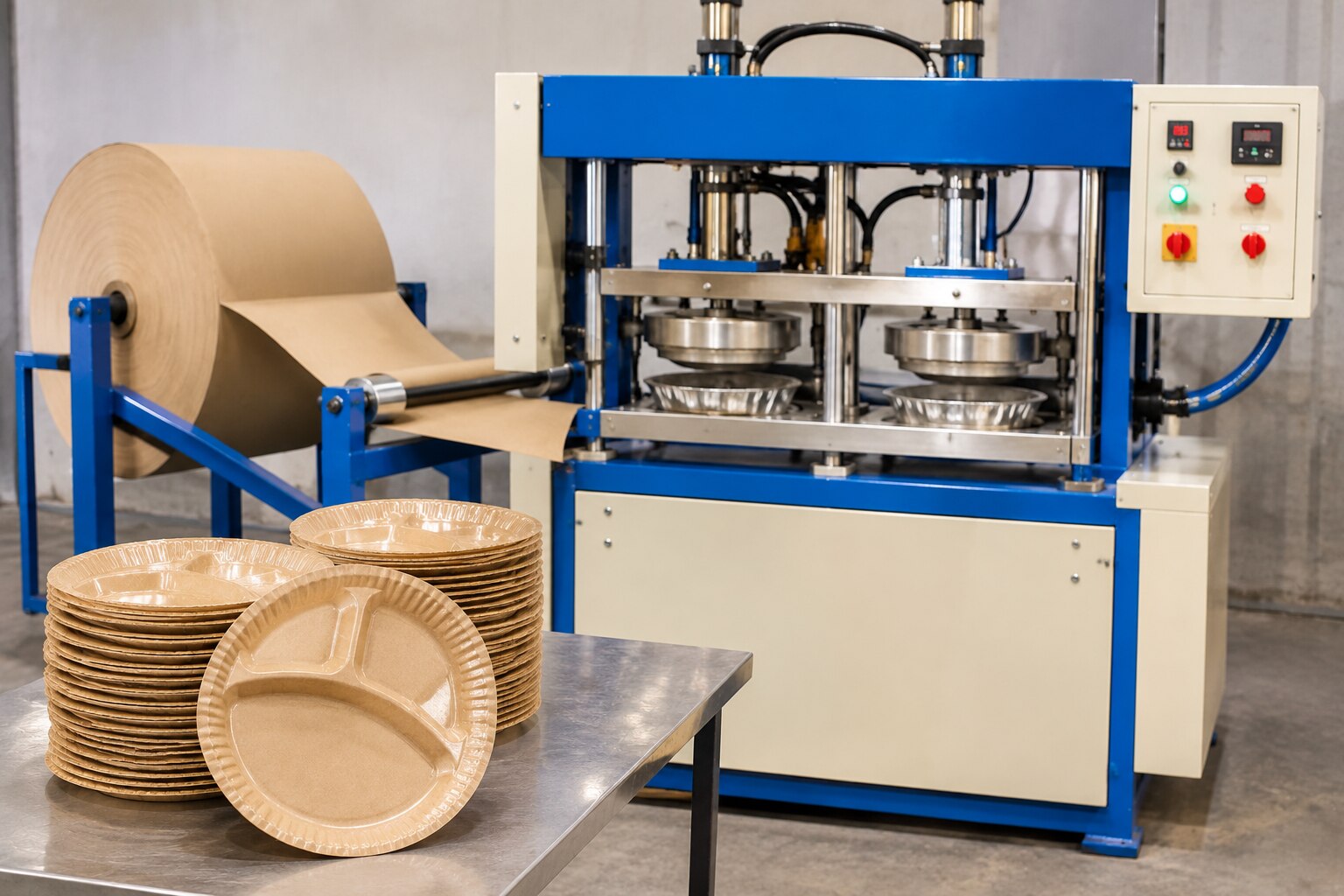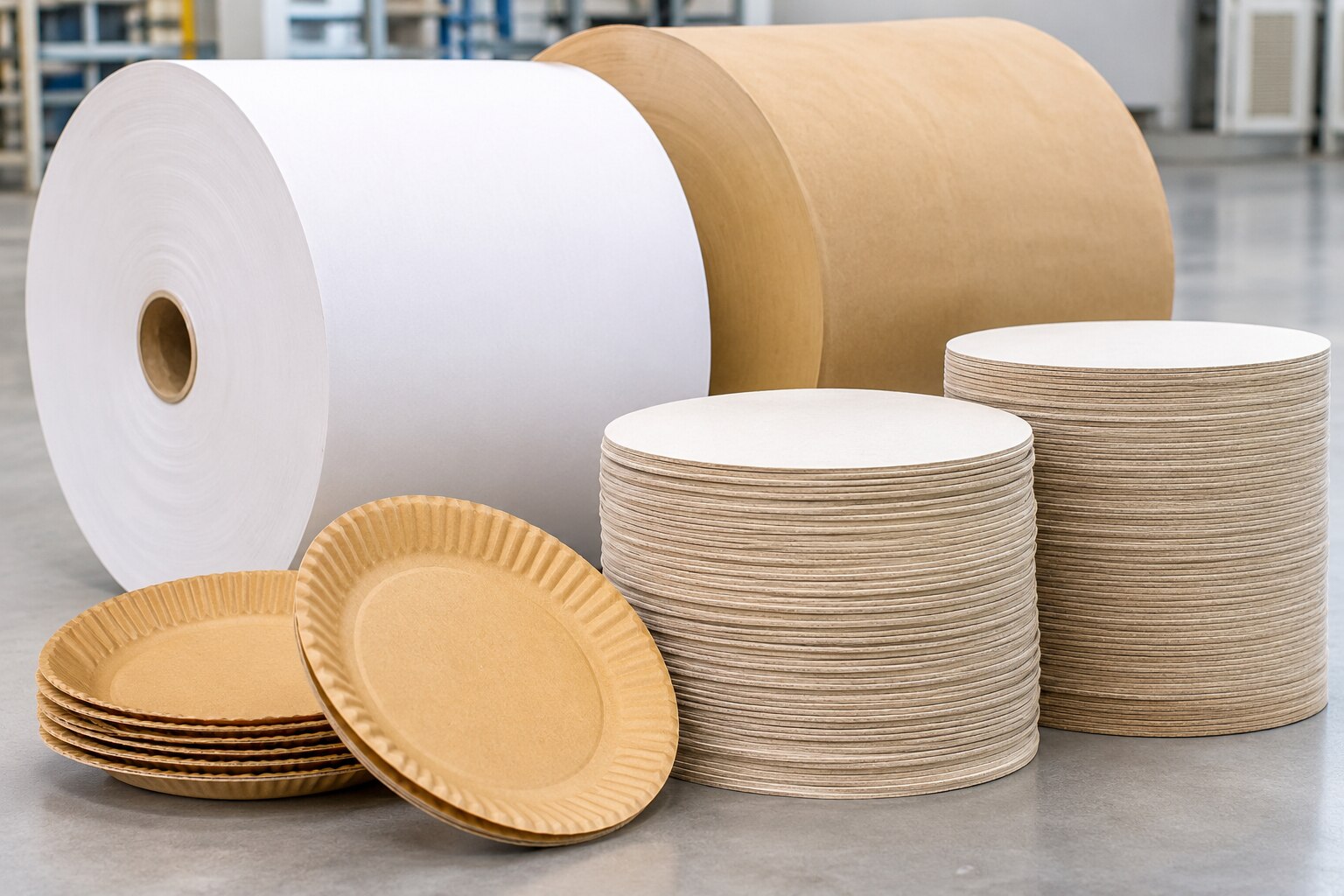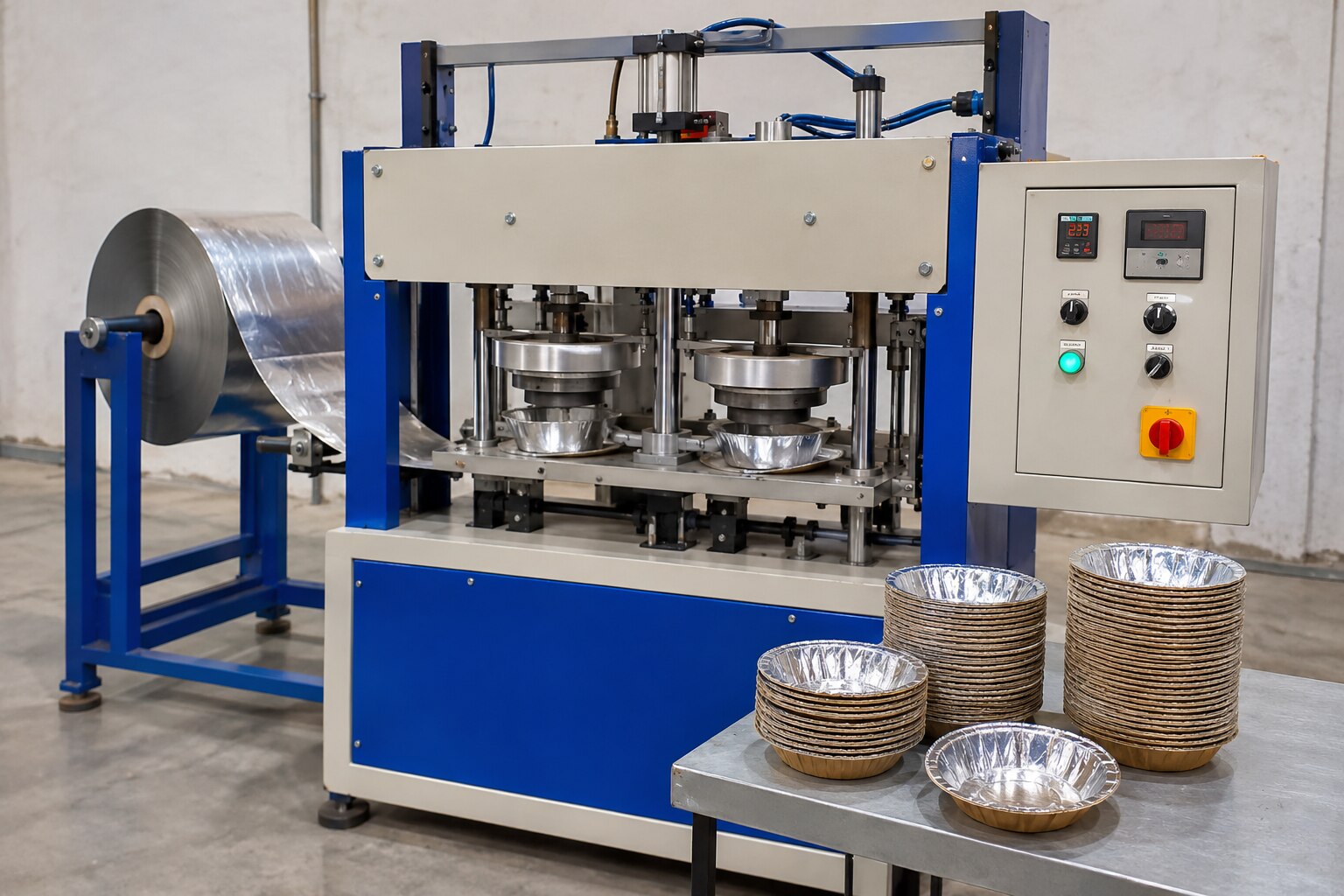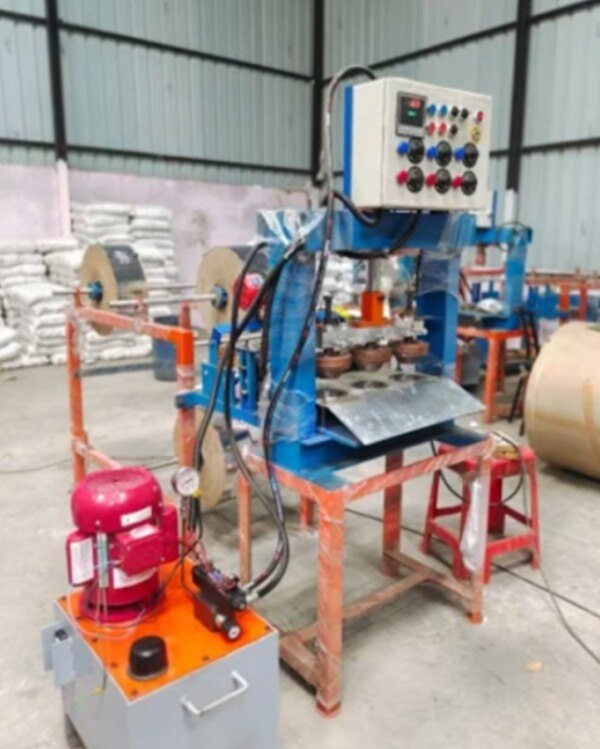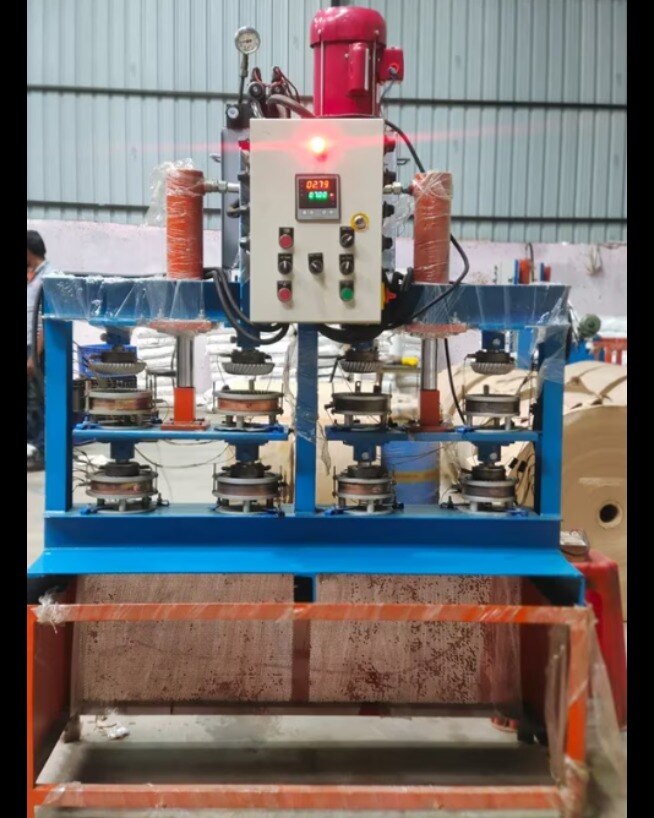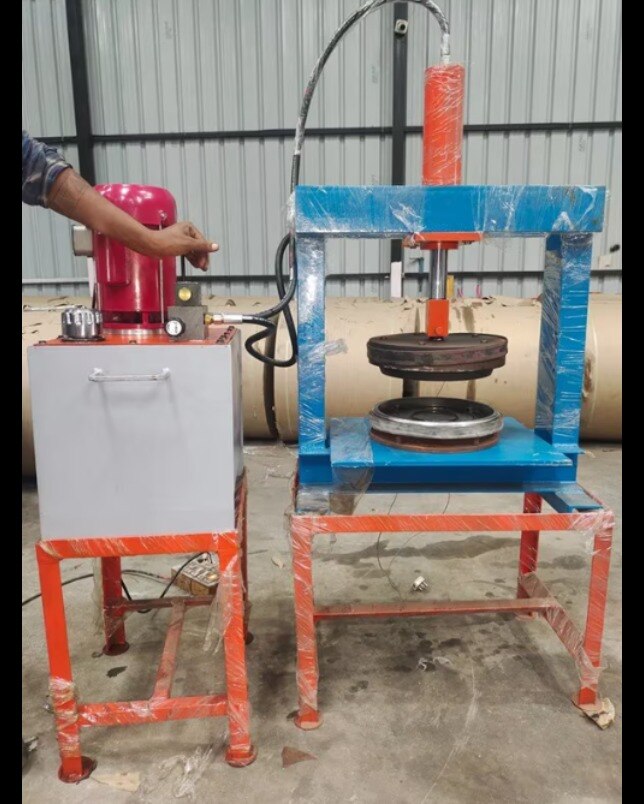
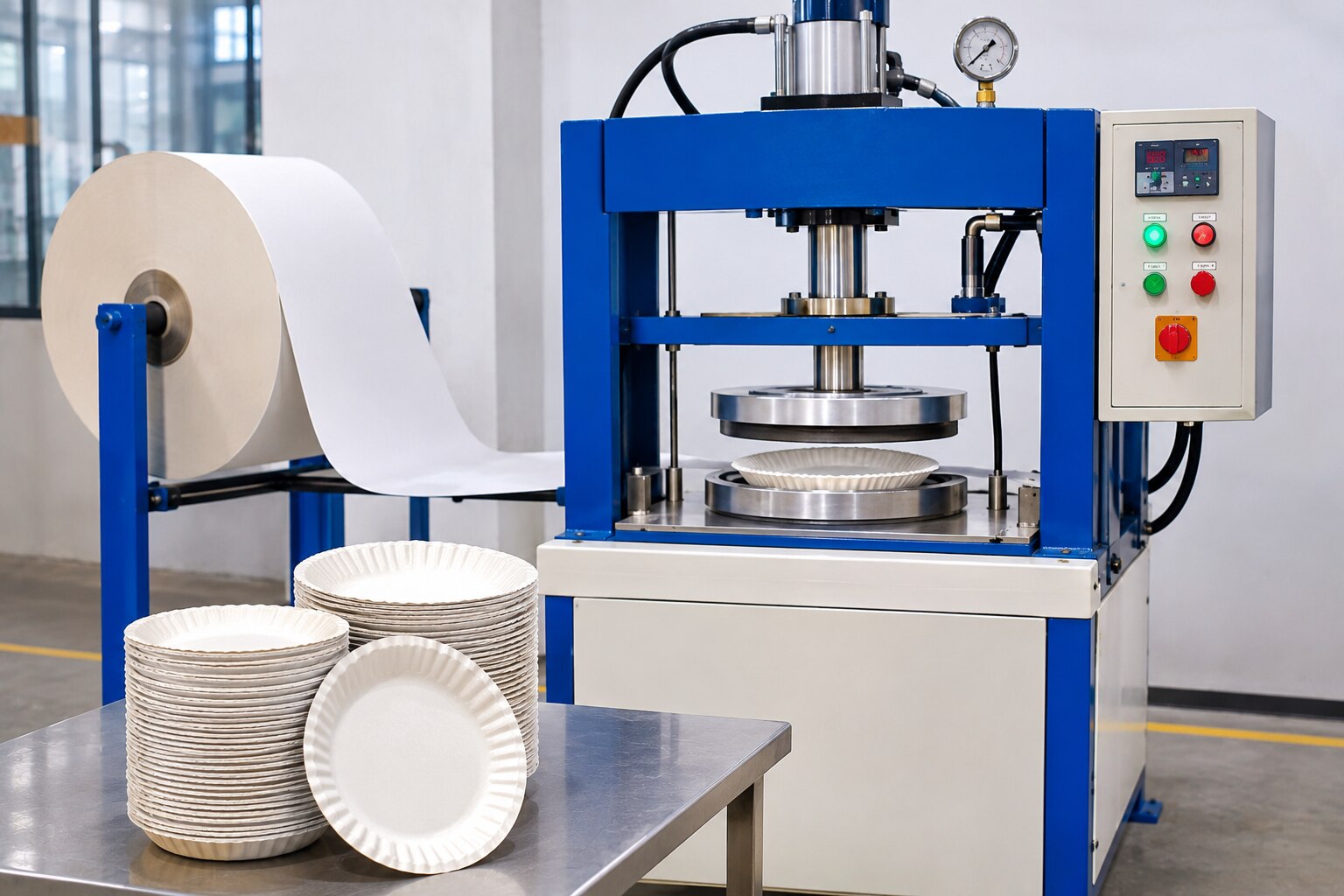
A hydraulic press does not create every plate size or shape through pressure adjustment alone: the matched die set determines the finished diameter, depth, rim and decorative profile. By the end, you will know how to specify tooling, paper blanks, machine settings and production trials without confusing a nominal size range with genuine multi-size capability.
Key takeaways
- Match upper and lower dies to the finished plate shape.
- Use paper blanks sized for the required diameter and design.
- Recheck alignment, force and cycle time after every tooling change.
- Run a documented trial before committing to a machine or die set.
The matched die set determines more than the plate diameter
A 4–18 inch claim describes possible hydraulic paper plate machine sizes, not every usable size between those numbers. The matched upper male and lower female paper plate forming die fixes the finished inside and outside diameter, forming depth, rim width, centre shape and clearance.
Stroke adjustment alone cannot turn a shallow flat-plate tool into a deep bowl tool.
- Shallow flat plate: uses a low-depth cavity, modest rim and broad, nearly level centre.
- Deep dona: needs a deeper cavity, longer material draw and controlled release; a deep dona die set is matched to that wall profile.
- Thali: uses a broader centre with a shaped or raised rim, so its outside diameter and usable depth differ from a flat plate.
- Compartment plate: uses dividing ribs and separate cavities in the male and female dies; changing only pressure will not create those partitions.
- Rolled-edge or wrinkle design: the die profile controls the rolled lip, radial wrinkle pattern and edge compression.
- Embossed design: matching raised and recessed details control the logo or texture; excessive depth can crack fibres, whiten paper or separate a coating.
Before accepting the advertised range, request each tool’s finished inside diameter, outside diameter and usable forming depth. Compare those figures, not the catalogue headline. Substantially different diameters or profiles normally require a matched male-and-female die pair, and often separate blanking or feeding tooling, because the blank must enter the cavity with the correct clearance.
Paper blanks must match the finished shape
A practical paper blank size is larger than the finished outside diameter because forming draws material into the sidewall, flange, and rolled or embossed rim. Start with this estimate: blank diameter ≈ base diameter + 2 × (developed sidewall length + flange and rim allowance).
Developed sidewall length is greater than forming depth when the wall slopes, so confirm the result with a forming trial rather than relying on diameter alone.
| Same nominal plate diameter | Why the blank differs | Production effect |
|---|---|---|
| Shallow flat plate | Short wall and narrow flange need less extra material | Lower paper use and easier nesting |
| Deep dona or thali | Greater developed wall length pulls more paper inward | Larger blank, higher force and more nesting waste |
| Rolled rim paper plate | The roll consumes a wider perimeter allowance | Larger blank, greater stiffness and stacking height |
| Embossed or compartment plate | Ridges and partitions draw material unevenly | Blank shape and centering need trial validation |
Qualify each design with these inputs:
- Paper GSM for paper plates, because heavier stock improves stiffness but can increase force, cracking and spring-back.
- Sheet versus pre-cut circle, including blanking tolerance and nesting layout.
- Coated paperboard or laminated stock, coating compatibility, release behaviour and any forming-temperature or conditioning requirement.
- Finished inside and outside diameters, forming depth, flange width, rim width and embossing pattern.
Two plates with the same nominal diameter can therefore use different blank diameters and consume different paper. A wider rim also changes perimeter length, blank nesting and load distribution.
A size or design change involves tooling, alignment and settings
Before calling a machine multi-size, confirm that it accepts interchangeable upper and lower dies, not merely different stroke settings. Check the die holders, mounting method, die dimensions and working clearance for every intended plate profile.
Request this tooling inventory:
- Upper and lower forming dies
- Die holders and mounting hardware
- Blanking dies, feed guides and ejectors
- Spacers and shims
- Separate requirements for a heated forming die
Die compatibility is machine-specific. A die from another press can fail because its mounting pattern, cylinder travel, daylight, cavity spacing or heated-die requirement does not match. The result can be an off-centre plate, damaged tooling or a cylinder that cannot close safely.
| Check | Why it matters | What to confirm |
|---|---|---|
| Mounting pattern | Bolt holes and locating features may differ | Drawing and fixing dimensions |
| Cylinder travel | The die may not reach forming depth | Usable stroke and shut height |
| Daylight | The assembled tooling may not fit | Maximum opening and die-set height |
| Cavity spacing | Multi-cavity sets need matched feeding | Centre-to-centre dimensions |
A paper plate machine changeover is more than swapping a mould. Record pressure, stroke, dwell, release, temperature and feed timing for each die set, then check blank centering, upper-to-lower alignment and ejector travel.
Ask the supplier to provide the actual changeover steps and total time in writing, including which components require removal, adjustment or shimming. “Quick change” is not a specification until those tasks are listed.
Hydraulic force and cycle time change with the design
Pressure at the gauge is not hydraulic press force. Peak force equals pressure multiplied by cylinder area, then changes with paper GSM, coating, blank diameter, forming depth, embossing density, die friction and compressed area.
A large-bore cylinder at lower pressure can outperform a small-bore cylinder at a higher gauge reading, so compare rated force and cylinder area, not pressure alone.
| Design | Load or time effect | Setup consequence |
|---|---|---|
| Shallow flat plate | Lower draw and shorter dwell | Excess pressure can whiten the sheet |
| Deep dona or thali | Greater draw, controlled dwell and release | Radial cracks or spring-back |
| Dense embossing | More compressed area and longer dwell | Incomplete pattern or coating delamination |
| Coated stock | Temperature and release affect friction | Sticking or delamination |
Paper plate machine cycle time includes blank feeding, die closing, pressure build-up, dwell, pressure release, opening and removal. A fast closing stroke does not guarantee high output; deep profiles need controlled dwell and release to prevent spring-back, while contaminated tooling or incompatible coating temperature can cause sticking.
A multi cavity die produces four pieces per cycle only when pressure balance, blank centering, die alignment and synchronized feeding keep every cavity within quality limits. Otherwise, one cavity creates rejects and nominal output hides paper plate forming defects.
Check these setup clues when defects appear:
- Rim wrinkles: off-centre blank, excess material, poor clearance or uneven pressure.
- Radial cracks: excessive draw or embossing depth.
- Whitening: excessive compression or pressure.
- Sticking: poor release clearance, contamination or incorrect coating temperature.
Use a documented trial to choose the right machine and tooling
A documented paper plate machine trial is the only reliable way to compare machines across sizes and designs. Run it with the actual blank diameter, paperboard, coating, artwork, embossing density and target cycle rate; a plain shallow plate trial does not validate a deep or heavily embossed design.
Use this paper plate machine buying checklist:
- Request finished inside diameter, outside diameter, usable forming depth, die drawings and compatible blank diameters for every proposed size.
- Record GSM and coating limits, cavity-wise sample results, rated press force, cylinder area, cycle breakdown and the full changeover scope, including dies, holders, guides, ejectors, spacers and settings.
- Require samples checked for rim wrinkles, radial cracks, coating delamination, whitening, spring-back, sticking and dimensional variation across cavities.
| Design | Trial evidence | Decision |
|---|---|---|
| Shallow flat plate | Target blank, diameter and cycle rate meet dimensions | Suitable only for that profile |
| Deep dona or thali | Full depth, controlled dwell and release produce crack-free walls | Confirm before ordering |
| Heavy embossing or compartments | Artwork and embossing density run in every cavity | Reject plain-plate evidence |
Request food-contact documentation for the food contact paperboard, coating, inks and adhesives. For relevant United States applications, check 21 CFR 176.170; for European Union markets, check Regulation (EC) No. 1935/2004.
Shivansh Engineering, a paper plate machinery supplier Pune, can help match machinery and raw materials to these documented requirements, not prove that every size or design is supported.
Related products
 | Automatic Paper Plate Making Machine Semi Automatic Hydraulic 4 Die Wrinkle Paper Plate Machine ₹180000 The Semi Automatic Hydraulic 4 Die Wrinkle Paper Plate Machine is a powerful and efficient production solution designed for manufacturers who want to... View product → |
 | Paper Plate Making Machine Automatic Hydraulic Double Die Paper Plate Making Machine ₹120000 The Automatic Hydraulic Double Die Paper Plate Making Machine is one of the most reliable and efficient solutions for manufacturers seeking faster... View product → |
Frequently asked questions
What determines a paper plate’s size and design?
The matched upper male and lower female die determines the inside and outside diameter, forming depth, rim width, centre shape and clearance.
Why must paper blanks match the finished shape?
A blank with the wrong diameter or shape can create uneven rims, wrinkles, incomplete forming or excess waste.
What changes when you switch plate sizes or designs?
A change involves the die set, die alignment, blank size, hydraulic settings and cycle-time settings.
Why do hydraulic force and cycle time change with the design?
Deeper forms, wider rims and more complex shapes alter forming resistance and material movement, so the machine settings and cycle time require verification.
Related products
 | Automatic Thali Making Machine Semi Automatic Hydraulic 8 Die Wrinkle Paper Plate Machine ₹290000 A Semi Automatic Hydraulic 8 Die Wrinkle Paper Plate Machine is a powerful and efficient manufacturing unit designed for high-volume production of... View product → |
 | Paper Plate Circle Cutting Machine Paper Plate Circle Cutting Machine ₹160000 A Paper Plate Circle Cutting Machine is an essential tool for manufacturers producing paper plates, donas, and disposable tableware. View product → |
 | Paper Plate Thali Making Machine Hydraulic Paper Thali Making Machine ₹110000 SHIVANSH ENGINEERING is engaged in offering a wide range of Hydraulic Paper Plate Making Machine to our clients. View product → |
 | Automatic Paper Plate Making Machine Fully Automatic All-in-One Paper Plate Machine ₹340000 The Fully Automatic All-in-One Paper Plate Machine is the ultimate choice for entrepreneurs and manufacturers who want a high-performance,... View product → |