A supplier’s quoted price cannot tell you whether its paper will feed accurately, form cleanly, resist food and moisture, or produce an acceptable yield on your machine. By checking the material specification, compliance file, production trial and delivery terms in sequence, you can compare suppliers on cost per usable plate rather than cost per kilogram alone.
Key takeaways
- Match GSM, caliper, fibre direction and strength to your die and product.
- Choose sheets, blanks or reels based on machine format and material yield.
- Request food-contact declarations, test reports and complete batch traceability.
- Approve samples only after inspecting them and running your own machine trial.
Match the paper specification to your product and forming die
The same GSM can produce very different plates. Before requesting quotations, define the finished product, blank geometry, forming die, and machine settings because caliper, bulk, density, fibre direction, and strength control stiffness and forming—not basis weight alone.
1. State the product: a small dona, flat plate, thali, wrinkle plate, or deep bowl. Record finished diameter, depth, rim width, blank diameter, and the die’s forming depth and radius.
2. Specify GSM, paper thickness, caliper tolerance, bulk, density, and machine-direction and cross-direction tensile or tear strength. Two papers with identical GSM can behave differently under the same die.
3. Define the construction: virgin or recycled fibre, coating or laminate type, coating weight, coating-weight tolerance, and coating uniformity. Excess coating can increase curl and forming waste; insufficient coating can cause liquid or grease breakthrough.
4. Give the moisture range required at shipment and the packaging method. Condition samples in your plant before testing, because moisture changes dimensions, stiffness, curl, and die-cutting behaviour.
5. Provide the forming machine’s die dimensions, heater settings, forming speed, and required output. For reel stock, add web width, core inside diameter, maximum roll mass, winding direction, splice policy, edge quality, and web-width tolerance.
Ask each paper plate raw material supplier to quote against this written specification and identify every permitted tolerance. A nominal GSM or paper thickness alone cannot predict flange cracking, distortion, poor stacking, or unreliable forming.
Choose the right sheet, blank or reel format for production
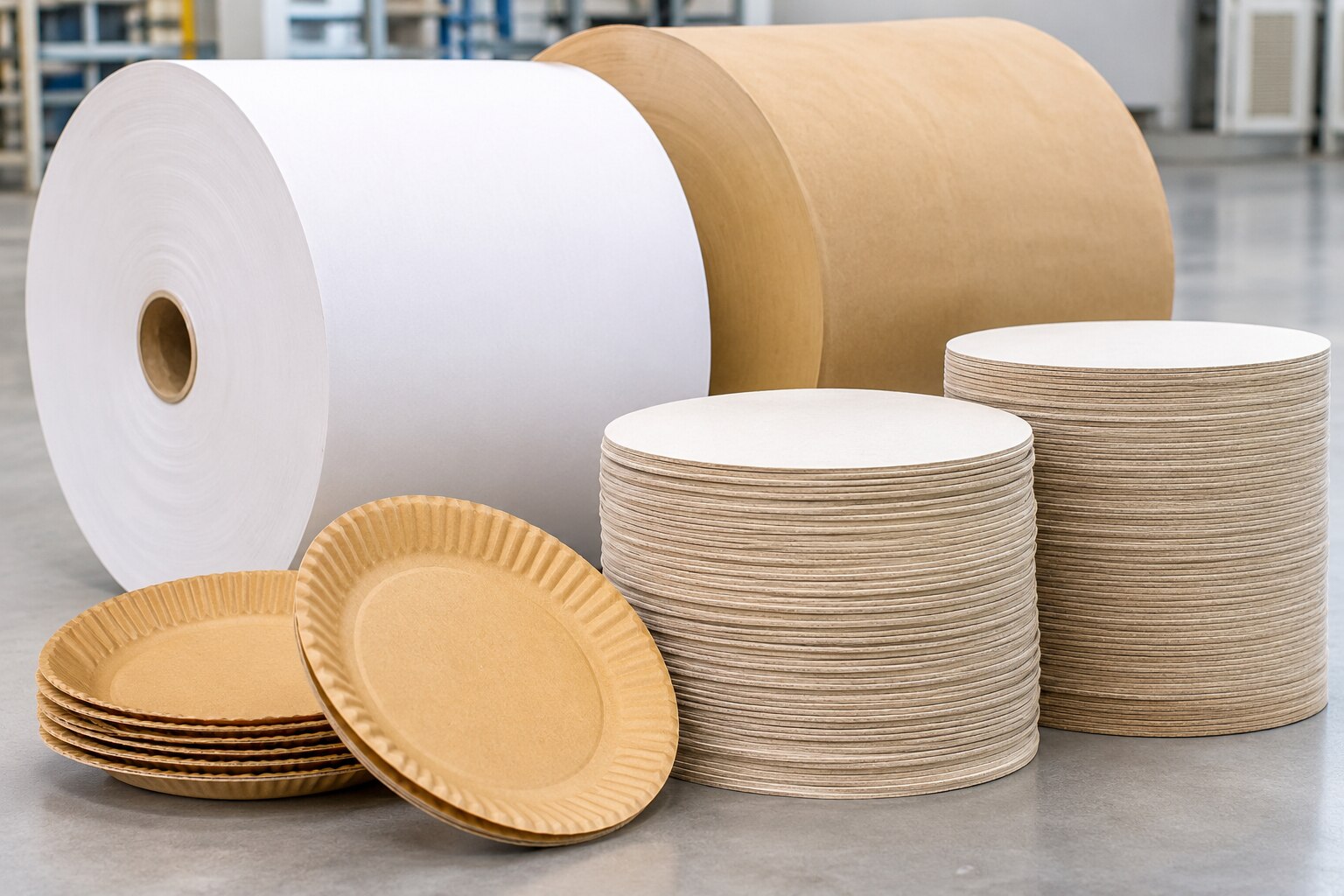
A blank that does not match the die will waste material before forming begins. Check the paper sheet format, blank dimensions and blank diameter tolerance against the feeder and mould: an oversized blank can catch the tooling, while an undersized one leaves a weak flange or an incomplete rim.
| Format | Feeding effect | Forming consequence |
|---|---|---|
| Flat sheets | Feed individually; suitable for manual or sheet-fed loading | Consistent blank placement, but frequent loading interrupts production |
| Pre-cut paper circles | Remove cutting at the machine; require accurate stacking and separation | A clean edge supports uniform rims; oval or feathered circles cause wrinkles and leaks |
| Reels | Support continuous feeding; require matched reel width and tension control | Fewer changeovers, but poor winding or web alignment creates skew, breaks and uneven plates |
For reel stock, confirm these production details before ordering:
- Reel width and web-width tolerance: excess width increases trim waste, while insufficient width can miss the die.
- Core inside diameter, outside diameter and maximum roll mass: a mismatch prevents mounting or overloads the unwinder.
- Winding direction, edge quality and roll hardness: loose edges telescope; crushed edges cause tracking faults.
- Splice policy and splice construction: an unmarked or thick splice can stop the feeder or damage the forming tool.
Match blank diameter to the product: small donas, deep bowls and thalis impose different draw depths and flange widths. Measure several blanks from each batch, not one sample. A supplier’s stated tolerance is useful only when it matches your machine’s actual feeding limit.
Compare material constructions and verify food-contact evidence
Compare the whole construction, not the word “paper” or “food grade.” Virgin paper gives predictable cleanliness, colour, odour and strength; recycled paper can reduce virgin-fibre demand but needs tighter checks for variation and direct-contact suitability. A recycled-content claim must state post-consumer or pre-consumer content and its calculation basis.
| Option | Main trade-off | Verify |
|---|---|---|
| Virgin paper | Consistent cleanliness, odour, colour and strength; usually easiest to form. | Confirm fibre grade and additives. |
| Recycled paper | Lower virgin demand, but greater variation in cleanliness, odour, strength and colour. | Request recycled-content details and food-contact evidence. |
| Coated paper | Better grease and liquid resistance; low or uneven coating causes breakthrough, curl or waste. | Check coating weight separately from paper basis weight and test uniformity. |
| Silver-coated paper | Reflective appearance does not prove food safety, antimicrobial performance or recyclability. | Require the silver-coated paper raw material supplier to identify the coating chemistry and its restrictions. |
| Laminated stock | Stronger barrier, but extra layers can affect forming, heat sealing and disposal. | Assess every layer, adhesive and interface as one construction. |
- Request a declaration for the complete article, covering sizing agents, wet-strength resins, dyes, mineral fillers, binders, coatings and adhesives.
- Match it to 21 CFR 176.170 or 176.180, named food types, temperatures and contact limits.
- Obtain the manufacturer, paper grade, batch number, coating-weight records and liquid/grease tests on finished plates.
- Check shipment moisture and packaging, then condition samples in your plant before testing.
- Treat compostability separately; demand EN 13432 or ASTM D6400/D6868 evidence for the complete construction.
Approve samples through inspection and a trial on your own machine
Reject a sample before machine testing if its delivered condition does not match the specification. Record these findings during sample inspection:
- Basis weight and caliper, measured at several points
- Blank or reel dimensions, including width and cutting accuracy
- Curl, stiffness, edge feathering and visible surface defects
- Coating appearance, odour and delamination
- Batch number, packing condition and moisture reading
Complete moisture conditioning before judging forming performance. Keep the sample in the production area under your normal plant conditions, then measure moisture again and run the trial. Paper gains or loses moisture in storage; the resulting dimensional change can cause poor feeding, web breaks, curl, flange cracking or distorted plates.
For coated or laminated stock, perform a coating weight test separately from the paper basis-weight check. Sample across the web and compare the readings with the supplier’s declared range. Low or uneven coating can allow water, oil or sauce to break through; excessive coating can increase curl and interfere with clean die cutting.
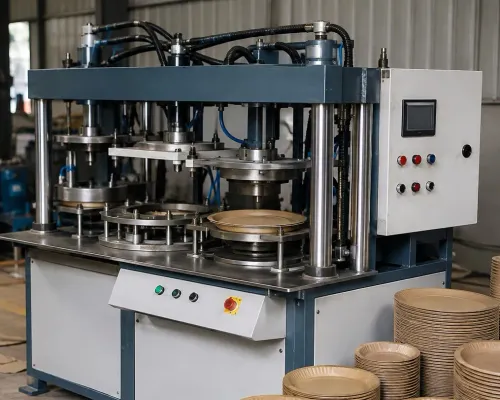
Run the sample on your own machine using the actual blank geometry, forming die, heater settings and production speed. Confirm forming die compatibility by checking feeding, blank seating, rim definition, stacking and release from the die. Inspect plates for cracks, wrinkles, delamination and distortion.
Fill finished plates with the intended hot liquid, oily food or sauce and hold them for the planned service period. Check the underside, rim and seams for seepage; a Cobb result alone cannot prove resistance to these foods. Approve the material only when repeated production runs deliver consistent plates without unacceptable waste.
Compare supplier reliability using yield, service and landed cost
Quoted price is only the starting point. Compare suppliers using cost per acceptable finished plate: total material and delivery cost divided by plates that pass leakage, shape, stacking and appearance checks.
| Measure | Supplier A | Supplier B | What to compare |
|---|---|---|---|
| Yield | Record basis-weight tolerance, usable web width, edge trim, roll waste and forming rejects | Record the same figures from an identical trial | Calculate acceptable plates from each tonne or roll |
| Coated-stock performance | Check coating weight, uniformity, grease and hot-liquid resistance | Check the same results on finished plates | Low coating weight causes breakthrough; excess or uneven coating causes curl, poor forming and die-cut waste |
| Service | Confirm minimum order quantity, lead time and stock availability | Confirm the same commitments in writing | A cheaper batch is costly if it stops your machine |
| Delivery cost | Add freight, unloading, packaging and rejected-stock replacement | Add the same charges | Compare landed cost, not invoice price |
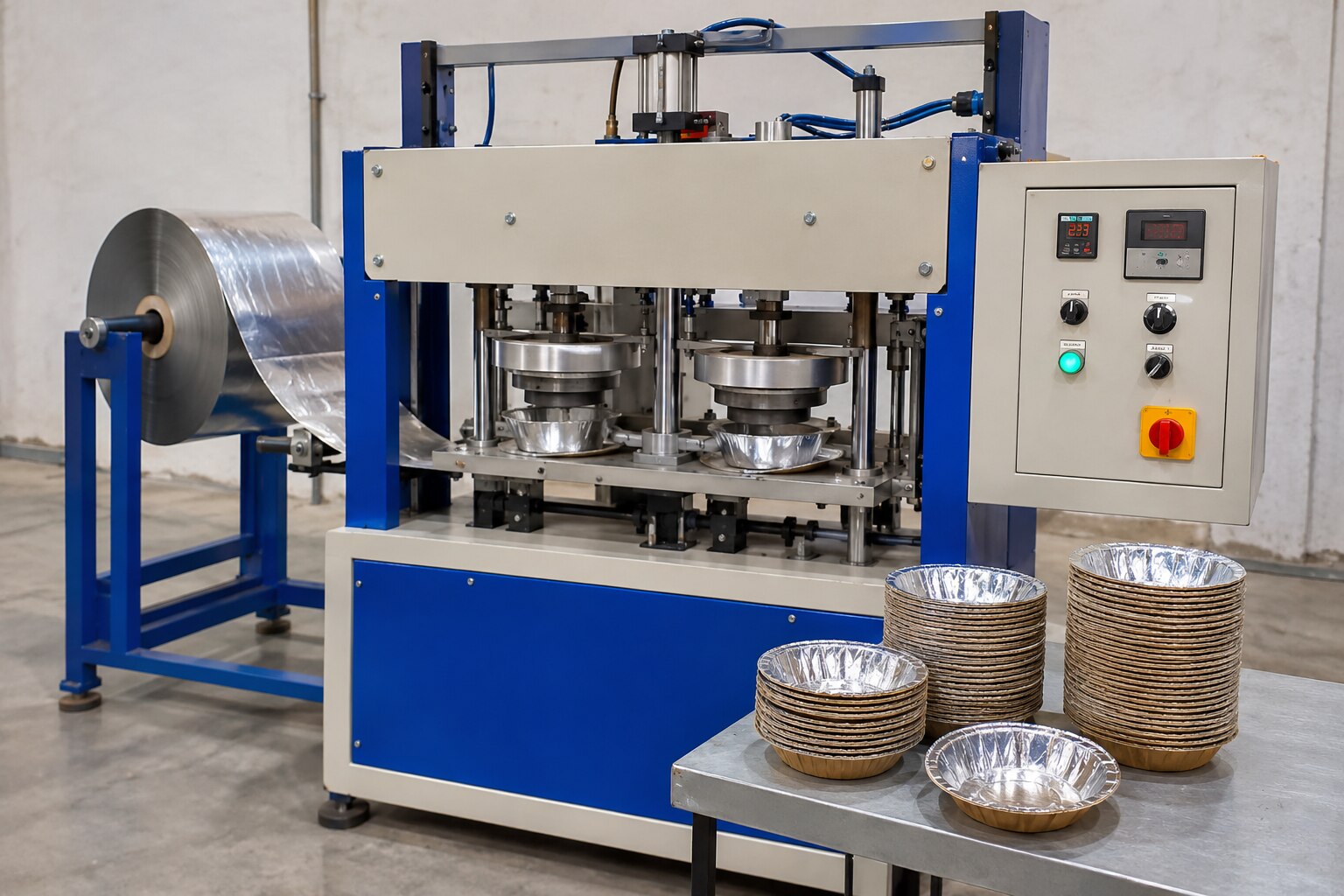
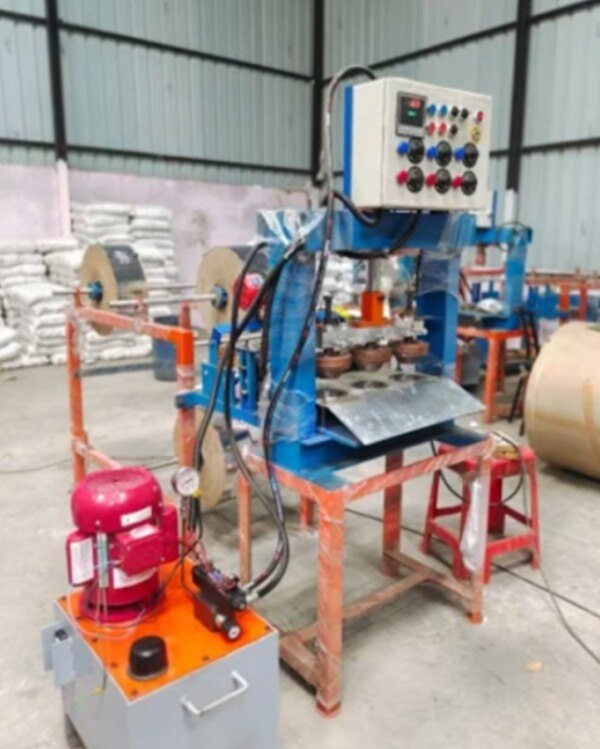
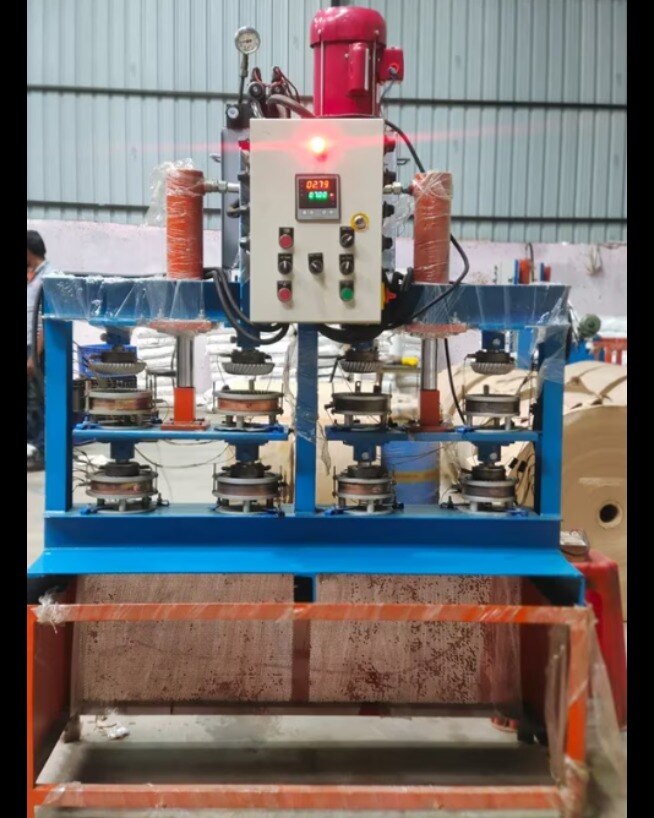
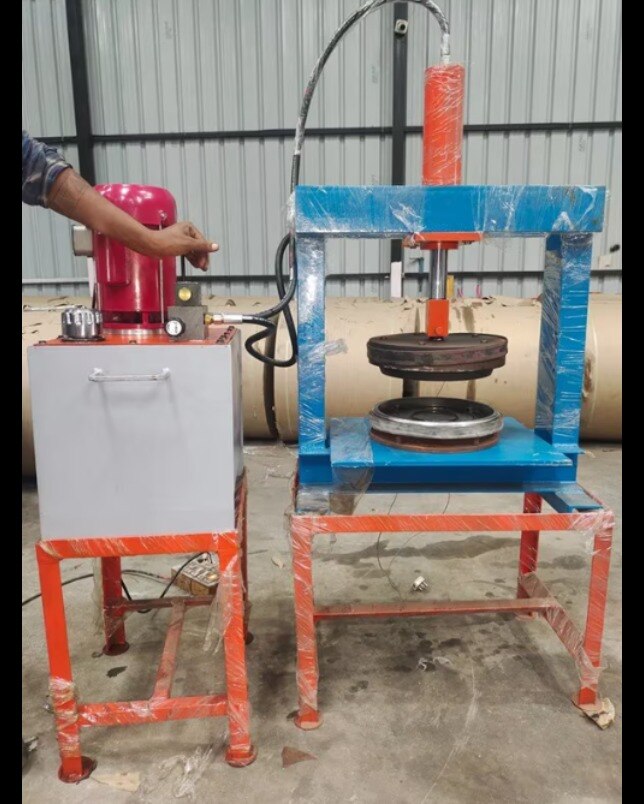
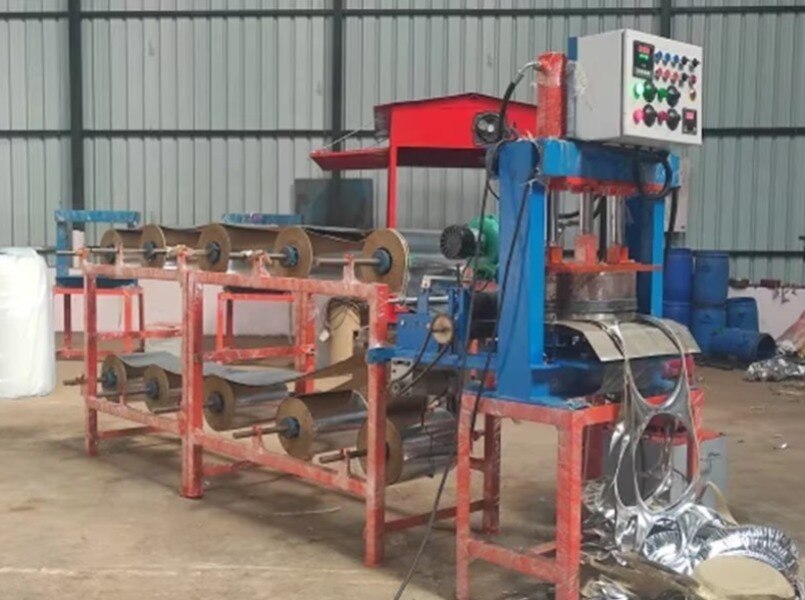
Run both materials with your actual blank geometry, die, heater settings and forming speed. If the machine is supplied by Shivansh Engineering, use its production setup rather than judging stock only from laboratory tensile or Cobb results.
Record splice frequency, web breaks, flange cracking, delamination, edge feathering, curl and downtime during the trial. Request batch-specific basis-weight, caliper and coating-weight records, then divide landed cost by the number of acceptable finished plates. That figure exposes the supplier who looks cheap per kilogram but wastes material and production hours.
Frequently asked questions
Which paper specifications matter besides GSM?
Check caliper, bulk, density, fibre direction and strength against the finished plate, blank geometry, forming die and machine settings.
Should you buy sheets, blanks or reels for paper plate production?
Choose sheets, die-cut blanks or reels according to your machine format, blanking process, storage capacity and expected material yield.
What food-contact evidence should a paper plate raw material supplier provide?
Request a food-contact declaration, relevant test reports, material composition details and batch traceability for the supplied paper.
How should you approve a paper plate raw material sample?
Inspect dimensions, caliper, surface and defects, then run the sample on your own machine to verify forming, stiffness, finish and production yield.